

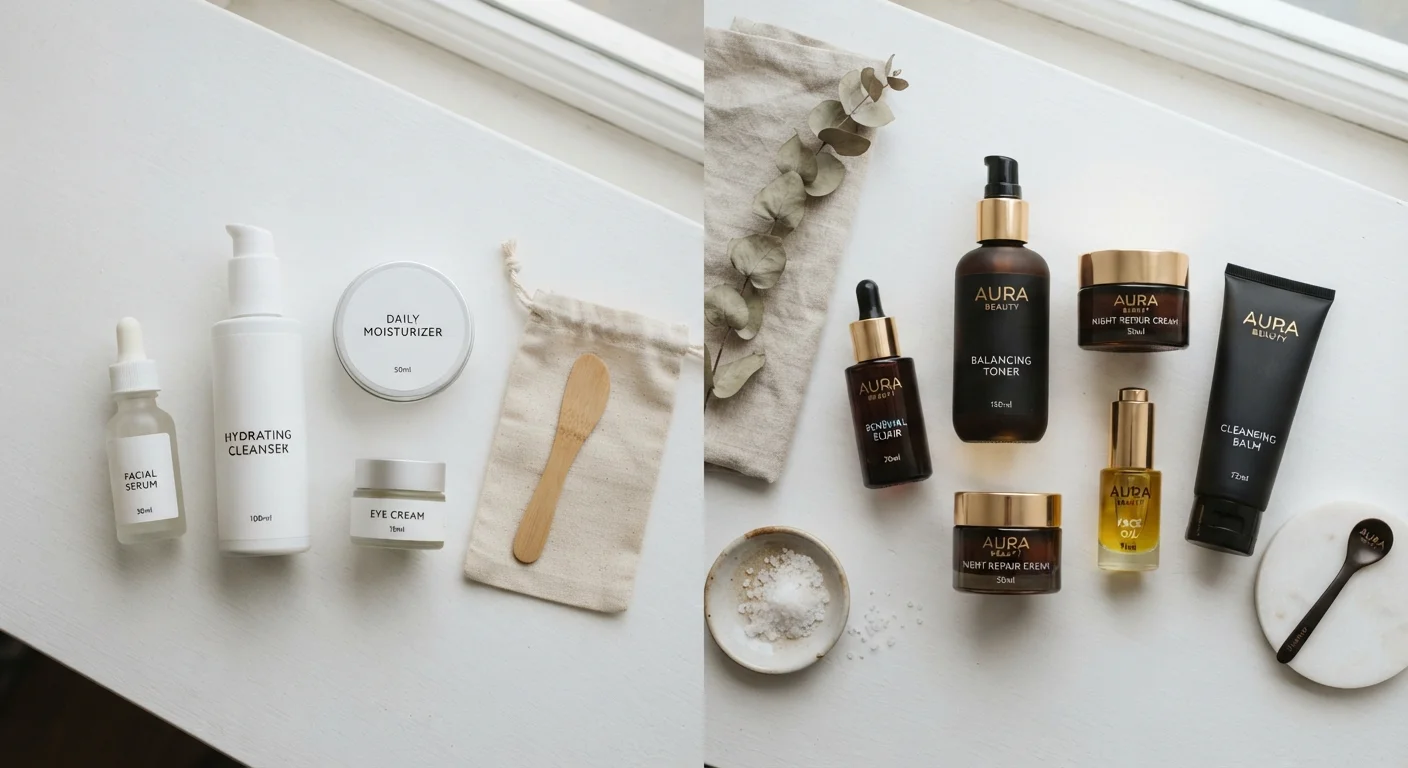
Option A
Drugstore skincare
The accessible, formula-focused option.
Best for: Shoppers who want clinically proven active ingredients without paying for brand prestige or luxury packaging.
Option B
Department store skincare
The prestige, full-experience alternative.
Best for: Consumers who value in-person consultations, sensory textures, and specific proprietary formulations not found at mass-market price points.
Where the price difference actually comes from
A department store moisturizer priced at $90 and a drugstore moisturizer priced at $15 may share several of the same functional ingredients. The gap is not purely about what is inside. A significant portion of prestige pricing reflects costs that never touch your skin: primary and secondary packaging, retail display space, counter staff salaries, sampling programs, and national advertising.
Industry cost analyses have consistently found that the raw ingredient cost in most skincare products, including prestige lines, accounts for a small fraction of the retail price. What consumers pay for at the high end is the full brand experience and the cost structure that supports it. That is not inherently deceptive, but it is worth understanding before you spend.
Drugstore products carry their own overhead too, but mass-market distribution and simpler packaging compress those costs considerably. The tradeoff is typically less sensory refinement and fewer in-store services, not weaker actives.
| Criterion | Drugstore skincare | Department store skincare |
|---|---|---|
| Average price range | $5 to $30 per product | $40 to $200+ per product |
| Active ingredient availability | Widely available, similar actives | Widely available, sometimes proprietary |
| Packaging and presentation | Functional, minimal | Premium materials, higher cost built in |
| In-store guidance | Self-service, limited staff support | Trained counter staff, sampling available |
| Formulation elegance | Functional; varies widely | Often more refined texture and feel |
| Clinical testing depth | Standard safety and stability testing | Often more extensive efficacy studies |
| Return/exchange policies | Store-dependent, often limited | Generally more flexible with returns |
What the ingredient lists actually show
Reading an ingredient list (called an INCI list) is the most direct way to compare two products across price tiers. Ingredients are listed in descending order of concentration, so position matters. A product that lists retinol or niacinamide near the top of the list contains more of that ingredient than one where it appears near the preservatives at the bottom.
Both drugstore and prestige lines use the same pool of cosmetic-grade raw materials. A hyaluronic acid molecule sourced for a $12 serum is chemically identical to one in a $95 serum. The meaningful differences, when they exist, come from concentration, formulation stability, delivery systems, and the presence of complementary ingredients that help actives penetrate or stay stable over time.
Some prestige products do use genuinely novel delivery technology or proprietary encapsulation that mass-market lines do not match. Those specific cases can justify a higher price for consumers whose skin responds to them. The point is that price alone does not confirm this: the ingredient list does. For a plain-language guide to which actives are worth focusing on, see this overview of active ingredients in affordable skincare.
Where each tier has a real edge
Drugstore skincare has a clear practical advantage in routine staples where the active ingredient is well-established and widely formulated. Sunscreens, basic retinol products, glycolic acid toners, and fragrance-free moisturizers are categories where affordable lines perform competitively and independent testing has repeatedly confirmed this.
Department store lines hold a more defensible position in a few specific areas. Formulation elegance matters for products you wear daily under makeup, because texture and absorption speed affect compliance. Prestige brands also benefit from more aggressive clinical testing programs, which can support claims more robustly. And for some proprietary ingredient complexes, there is no equivalent at the drugstore regardless of budget.
A practical approach is to anchor a routine in drugstore products for high-usage steps like cleanser, SPF, and basic moisturizer, then selectively spend more on categories where a specific formulation has performed noticeably better for your skin. Building a routine around what your skin actually needs is a useful companion to that process.
Dermatological evidence on price versus performance confirms that the correlation between cost and skin results is weak across the category as a whole.
Making a mixed approach work in practice
Most people who research skincare carefully end up with a mixed routine, not a fully prestige or fully drugstore shelf. The question worth asking for each product slot is whether the higher price delivers something the lower-priced option does not: a more stable retinol, a lighter feel, a better-tolerated fragrance profile, or a clinically documented concentration of an active.
When the answer is no, the drugstore version is the rational choice. When a prestige product genuinely performs differently on your skin and you can afford it, that spending is justified. The goal is to make that call deliberately rather than default to price as a proxy for quality.
If you are starting from scratch or rethinking an existing routine, a budget-conscious approach to stocking a full routine can help prioritize where each dollar goes. And for those new to skincare altogether, this starter guide covers the essentials without overcomplicating the process.
The content provided on our blog site traverses numerous categories, offering readers valuable and practical information. Readers can use the editorial team’s research and data to gain more insights into their topics of interest. However, they are requested not to treat the articles as conclusive. The website team cannot be held responsible for differences in data or inaccuracies found across other platforms. Please also note that the site might also miss out on various schemes and offers available that the readers may find more beneficial than the ones we cover.