

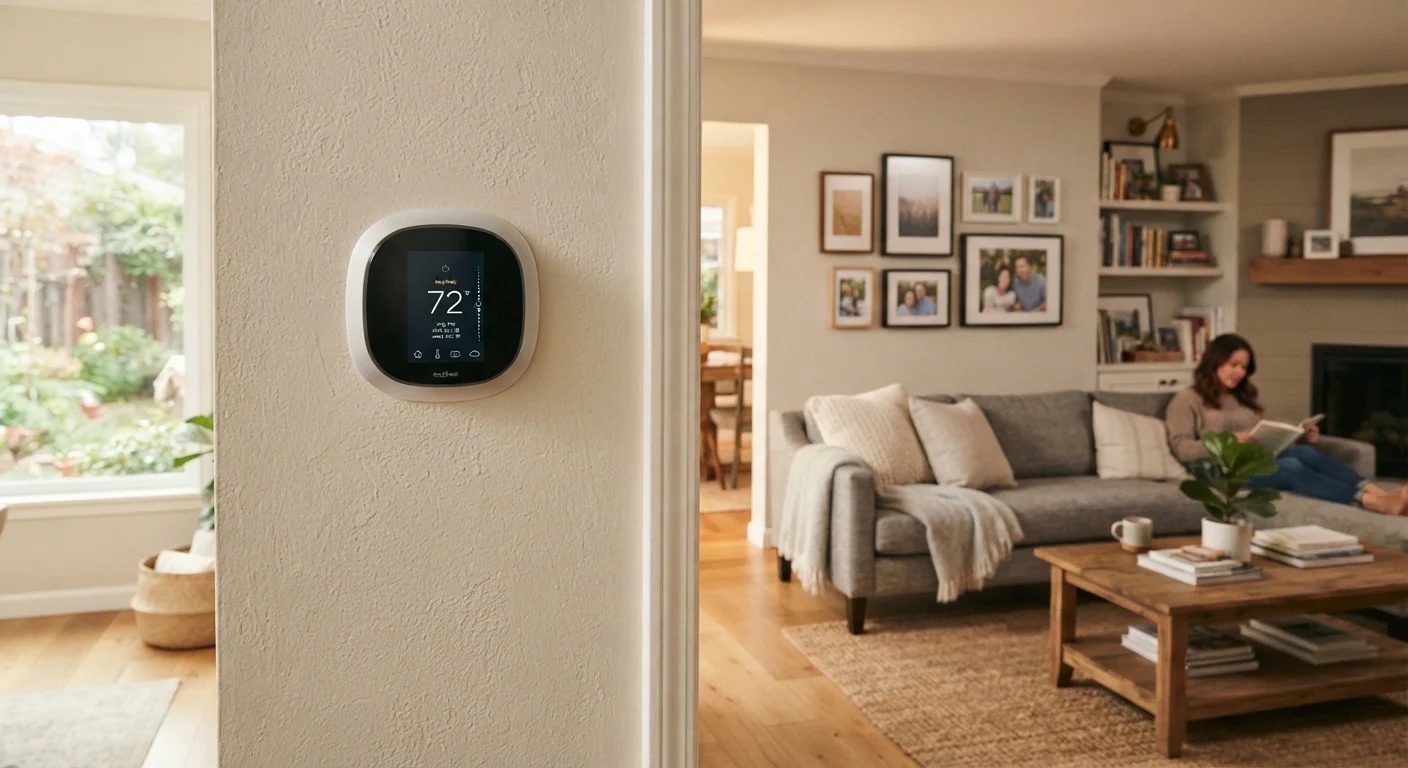
Option A
Programmable thermostat
The set-it-and-forget-it approach to scheduled temperature control.
Best for: Households with consistent daily routines who want reliable, low-maintenance temperature scheduling.
Option B
Smart thermostat
The adaptive, app-connected option for hands-on energy management.
Best for: Households with variable schedules or multiple occupants who want remote control and usage data.
Why the thermostat choice matters for your energy bill
Heating and cooling account for roughly 45 to 50 percent of a typical U.S. household's annual energy bill, according to the U.S. Department of Energy. That share makes the device controlling your HVAC system one of the more consequential spending decisions in a home. Both programmable and smart thermostats can lower that cost compared to a manual thermostat, but they do so differently and suit different households.
The core distinction is how each device handles schedule flexibility. A programmable thermostat runs a fixed program you enter manually: for example, 68 degrees on weekday mornings, a setback to 60 degrees while the house is empty, then a return to comfort before the family arrives home. A smart thermostat does the same thing, but adds connectivity, usually via Wi-Fi, so you can override the schedule remotely, and many models include occupancy sensors or learning algorithms that adjust settings automatically.
For a fuller picture of low-effort ways to cut utility spending, see practical steps to reduce utility bills without a renovation.
| Criterion | Programmable thermostat | Smart thermostat |
|---|---|---|
| Typical purchase price | $20 to $60 | $150 to $300+ |
| Remote control via app | No | Yes |
| Occupancy sensing | Rarely | Many models |
| Energy usage reports | No | Yes |
| Requires Wi-Fi | No | Yes |
| Learning/auto-scheduling | No | Some models |
| C-wire often needed | Sometimes | Usually |
| Best for irregular schedules | Limited | Well suited |
What the energy savings data shows
The U.S. Department of Energy has noted that turning a thermostat back 7 to 10 degrees Fahrenheit for 8 hours a day can reduce annual heating and cooling costs by around 10 percent. That figure applies to either thermostat type, provided the setback schedule is actually followed. A programmable thermostat that sits on its default factory settings saves nothing. A smart thermostat whose schedule was never configured performs no better.
45-50%
Share of home energy bill from heating/cooling
According to the U.S. Department of Energy, space conditioning is the single largest energy expense in most American homes.
~10%
Potential annual savings from consistent setback
The U.S. Department of Energy estimates this saving when a thermostat is set back 7 to 10 degrees for 8 hours daily.
$20-$60
Typical programmable thermostat cost
Basic programmable models are widely sold at hardware stores and online, with installation generally suitable for DIY.
Smart thermostat manufacturers have published their own savings estimates, though these figures come from their own research and should be treated as directional rather than guaranteed. Independent testing has generally found smart thermostats perform similarly to well-programmed manual-schedule models when household routines are predictable. The edge for smart models tends to appear when occupancy is irregular, because occupancy sensors can trigger setbacks that a fixed schedule would miss.
Payback period is worth calculating before purchasing. A programmable thermostat at $40 that saves $60 annually pays back in under a year. A smart thermostat at $200 with the same annual savings takes roughly three years. Local energy rates, home size, and how well you would actually use each device's features all affect that math. Thermostats are just one piece of the picture; other overlooked household spending areas can add up just as quietly.
Practical considerations before you decide
Compatibility is the first thing to check. Most programmable and smart thermostats require a common wire (C-wire) for continuous power. Older homes with two-wire systems may need an adapter or a different model entirely. Smart thermostats with Wi-Fi connectivity also require a home network and, in most cases, a smartphone to access their full feature set.
Installation for both types is generally straightforward and does not require a licensed professional in most jurisdictions, though you should confirm your local requirements and turn off power at the breaker before touching any wiring. If your HVAC system is complex (multi-stage, heat pump, or radiant), verify that any thermostat you consider supports your specific setup before purchasing.
Household buy-in matters too. A smart thermostat's learning features and remote controls only help if occupants understand how to use them. For homes where one person manages everything and others override the thermostat manually, a simpler programmable model may hold its settings more reliably. Thinking through the time-versus-money trade-off is a useful frame here: the convenience features in a smart thermostat cost more upfront and require some ongoing attention to deliver their potential savings.
The content provided on our blog site traverses numerous categories, offering readers valuable and practical information. Readers can use the editorial team’s research and data to gain more insights into their topics of interest. However, they are requested not to treat the articles as conclusive. The website team cannot be held responsible for differences in data or inaccuracies found across other platforms. Please also note that the site might also miss out on various schemes and offers available that the readers may find more beneficial than the ones we cover.