

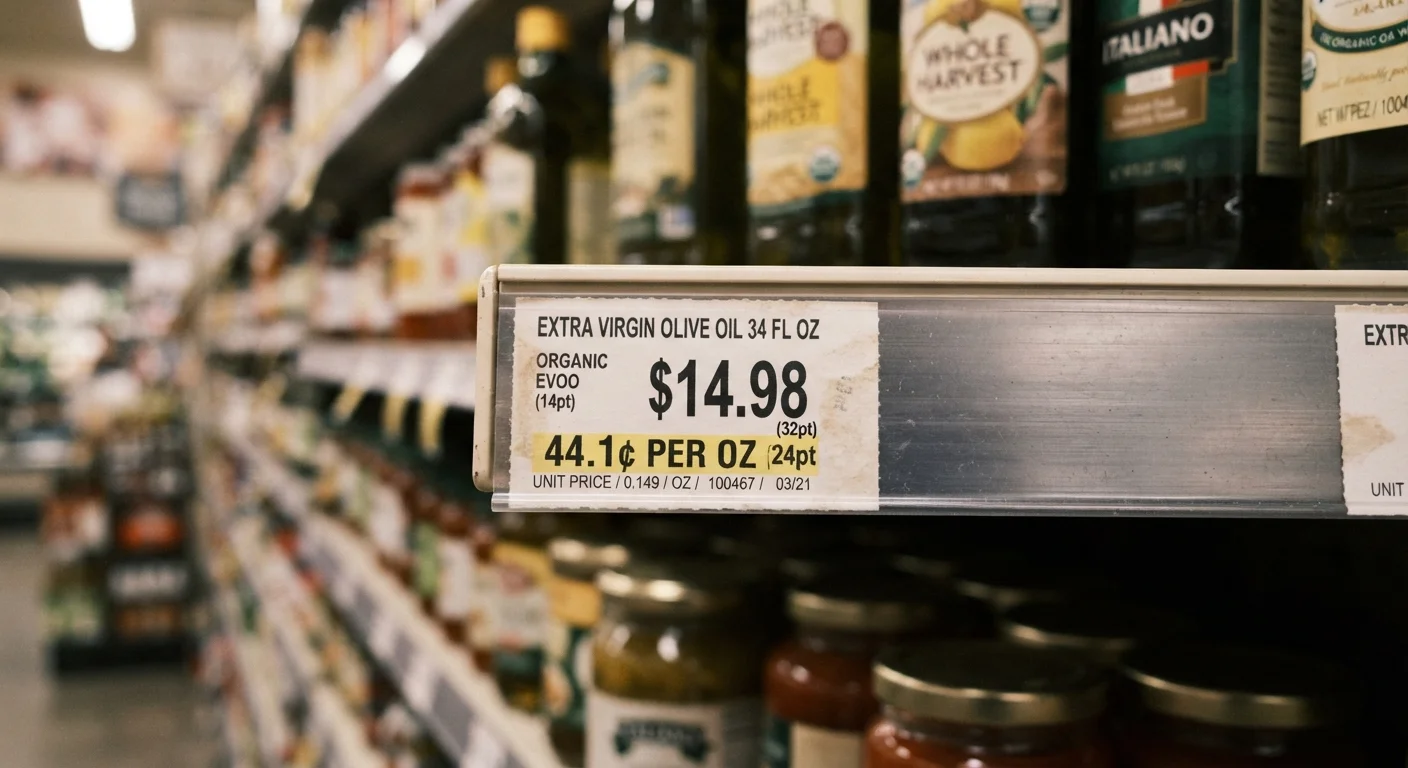
What the shelf label is actually telling you
Every grocery shelf tag has at least two numbers. The large one is the price you pay at checkout. The small one, often in a corner of the label, is the unit price. That smaller figure tells you what one ounce, one count, one square foot, or one liter of that product costs.
The unit of measurement depends on the product category. Paper towels are priced per sheet or per square foot. Cereal is priced per ounce. Dish soap is priced per fluid ounce. Canned goods are usually per ounce. When every product in an aisle is expressed in the same unit, you can compare them directly without mental gymnastics.
Many shoppers scan the big price and move on. The unit price is the figure that actually answers the question: which of these is worth my money?
Why size and packaging can mislead you
Package design and promotional placement are built to attract attention, not to make comparison easy. A large container with a bold sale sticker can look like a clear win, but its unit price may be higher than the smaller package sitting next to it at full price.
This happens for a few reasons. Manufacturers sometimes reduce package size while keeping the price the same, a practice sometimes called "shrinkflation." A store may run a promotion on a mid-size package that genuinely beats the bulk option. A store-brand item in a smaller can may undercut the name-brand family size on a per-ounce basis.
Check the unit price before assuming size wins
When two package sizes are side by side, read the unit price on both shelf tags before putting either in your cart. Larger packages have a lower unit price more often than not, but promotions, store-brand pricing, and package size changes mean it is not guaranteed. Ten seconds of checking removes the guesswork.
Common habits that quietly inflate grocery bills often include skipping the unit price and defaulting to whichever package looks like the better deal. Checking the small number takes a few seconds and short-circuits that assumption.
Where unit pricing falls short
Unit pricing is reliable when the labels are current and the units match across products. Both conditions sometimes fail in practice.
Sale tags do not always reflect a recalculated unit price. If a store drops the price on a product mid-cycle, the unit price on the tag may still show the pre-sale figure. When you see a sale sticker layered over the original label, it is worth doing the division yourself.
Unit mismatch is the other problem. Two pasta sauces may list unit prices in different measurements if one is sold by weight and another by volume. Comparing ounces to fluid ounces only works cleanly for products with similar densities. For products like honey or peanut butter, the difference is small enough to be a useful approximation, but it is worth knowing the labels are not perfectly equivalent.
Unit pricing rules vary by state
Many states require grocery retailers above a certain revenue or store-count threshold to display unit prices, but the specifics vary. Some states mandate it only for certain product categories. If you shop at a smaller independent store that does not display unit prices, dividing the retail price by the package size gives you the same information.
Produce priced per pound already gives you a direct unit comparison, so no separate math is needed there. The comparison challenge arises with pre-packaged produce, where a 1-pound bag and a 3-pound bag may carry different per-pound prices.
How to use unit pricing as a weekly habit
The most practical approach is to focus on categories where you spend the most or buy the most often. Staples like cooking oil, canned tomatoes, dried beans, pasta, and breakfast cereal are good starting points because prices on those items shift regularly with promotions.
When comparing two options, look at the unit price first, then consider how much of the product your household will actually use before it expires. A lower unit price on a 5-pound bag of flour is only useful if you bake often enough to use it. Waste cancels out savings.
For shelf-stable items you buy reliably, knowing the unit price threshold that counts as a good deal gives you a mental baseline. If canned black beans at a good unit price appear, you know it is worth stocking up. That kind of informed decision does not require a spreadsheet, just familiarity with the numbers you check regularly.
30+
U.S. states with unit pricing laws on the books
According to the National Conference of State Legislatures, more than 30 states have enacted some form of unit pricing regulation for retail food stores, though coverage and enforcement differ.
$1,500+
Estimated annual household food spending gap from inefficient purchasing
USDA Economic Research Service data indicates that American families lose meaningful sums annually to food waste and suboptimal purchasing, with package-size misjudgment a contributing factor.
Frequently Asked Questions
The unit price is the cost of one standard unit of a product, such as one ounce or one count. It appears in small print on the shelf tag below the total retail price. It is there so shoppers can compare products that come in different package sizes without doing complicated division.
No. Bulk and family-size packages often have lower unit prices, but that is not a rule. Promotions on smaller sizes, seasonal clearance, and store-brand pricing can all flip the usual pattern. Always check the unit price rather than assuming size determines value.
Requirements vary by state. Many states mandate unit pricing for grocery retailers above a minimum size, but the rules differ on which product categories must be labeled. If a store does not display unit prices, you can calculate your own by dividing the total price by the number of ounces or units in the package.
Produce sold loose by the pound already uses a per-pound price as its main price, so no separate unit label is needed. The comparison question arises when produce is pre-packaged at different weights, in which case unit pricing applies the same way it does for packaged goods.
Divide the total price by the total number of units in the package. For example, a 28-ounce jar priced at $3.36 works out to $0.12 per ounce ($3.36 / 28). Most smartphone calculators handle this in a few seconds.
The content provided on our blog site traverses numerous categories, offering readers valuable and practical information. Readers can use the editorial team’s research and data to gain more insights into their topics of interest. However, they are requested not to treat the articles as conclusive. The website team cannot be held responsible for differences in data or inaccuracies found across other platforms. Please also note that the site might also miss out on various schemes and offers available that the readers may find more beneficial than the ones we cover.