

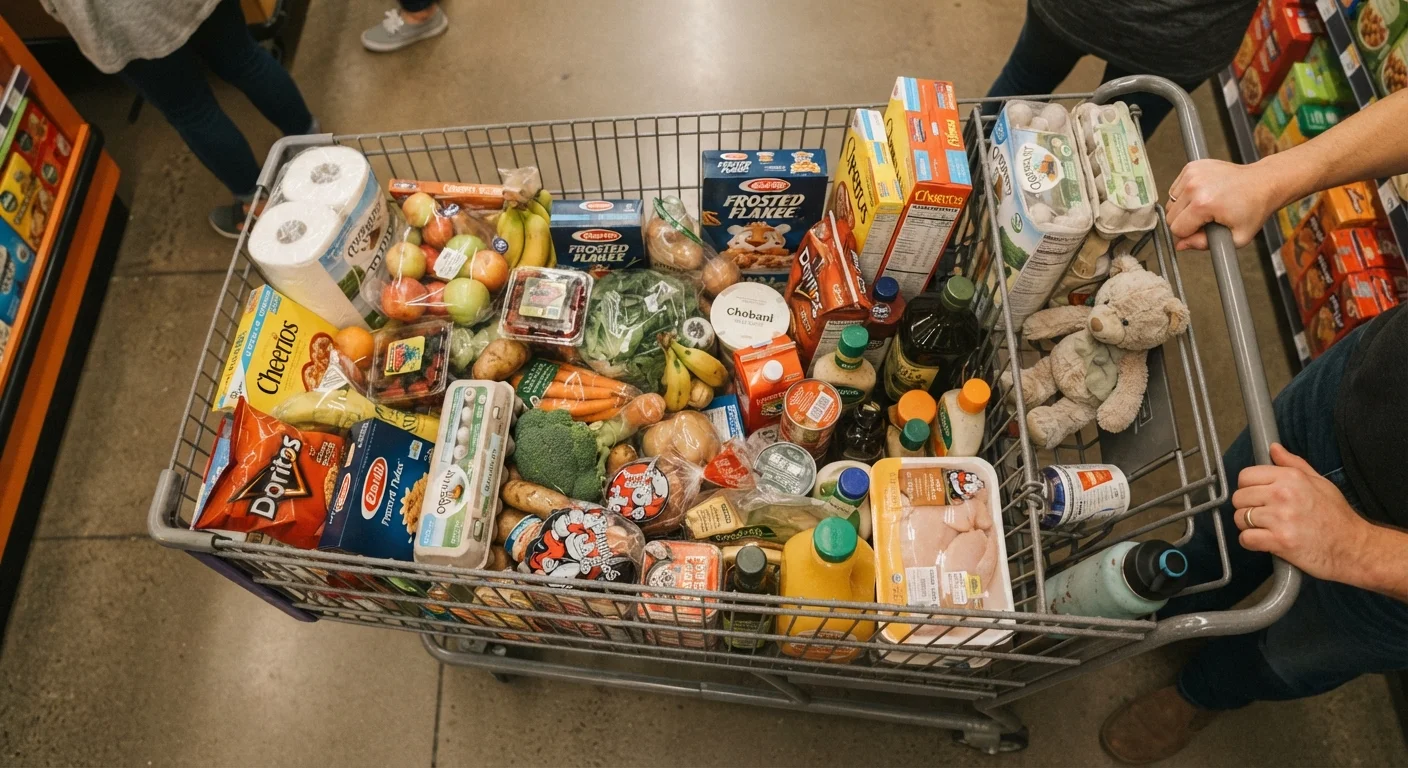
Why grocery overspending is hard to notice
Grocery bills climb gradually. No single purchase feels extravagant, so families rarely connect individual habits to the total at the register. The USDA tracks food-at-home spending across household types, and moderate-cost meal plans for a family of four run several hundred dollars per month. Small inefficiencies in how a family shops, not just what they buy, can push actual spending well above those benchmarks.
The patterns below are not about deprivation. They are about closing the gap between what a family intends to spend and what actually leaves the account. For a broader look at where household money quietly disappears, the household budget leak guide covers categories beyond food as well.
Shopping without a written list and a loose meal plan for the week.
Why it happens: Many shoppers expect to remember what they need, or they browse to figure out what sounds good. Both approaches lead to duplicate purchases, forgotten staples, and items that never get used.
Defaulting to pre-cut, pre-washed, or individually portioned convenience packaging.
Why it happens: Convenience packaging saves prep time, which feels worth the price in a busy week. The markup, however, is substantial: pre-cut vegetables, shredded cheese, and single-serve snack bags routinely cost 40 to 60 percent more per ounce than their whole equivalents.
Skipping unit price labels and comparing only the sticker price on the shelf.
Why it happens: The total price of an item is printed in large type; the unit price (cost per ounce, per count, or per pound) is printed small and easy to ignore. Shoppers naturally anchor to the sticker price.
Shopping while hungry or without a firm spending target for the trip.
Why it happens: Hunger raises the appeal of anything that looks ready to eat, and an undefined budget gives no feedback when the cart creeps over. Both conditions make impulse purchases easy to justify.
Ignoring store-brand options and buying national brands out of habit.
Why it happens: Familiar packaging feels reliable. Many shoppers never try the store brand because they assume quality is lower, even for products where the difference is small or undetectable.
Letting perishables go to waste by buying more fresh food than the household can use.
Why it happens: Fresh produce and proteins look appealing and feel like healthy choices in the moment. Without a plan for when each item will be used, they sit until they spoil.
Habits that look fine but cost more than expected
Several common shopping behaviors feel practical or even thrifty in the moment but consistently produce higher totals. Planning gaps are the most common source. A family that shops without meals in mind buys ingredients that do not combine into complete meals, then fills the gap with takeout or last-minute items later in the week. That pattern shows up in why grocery bills climb even with planning, where small structural gaps in the weekly routine account for a large share of the overage.
Convenience packaging is the second most common source of overage that families underestimate. The time savings are real, but the cost accumulates across dozens of line items in the cart. Switching even four or five items from convenience format to whole format each week can reduce the total meaningfully over a month.
Small overages add up fast
A family that overspends by $15 to $20 per weekly shop pays between $780 and $1,040 more per year than necessary. Most of that overage comes from habits that feel normal, not from big one-time splurges. Identifying even two or three of the patterns below can make a real difference over a full year.
Store-brand skepticism is worth revisiting if your household has not tried store-brand staples recently. Formulations change, and many store brands are now produced in the same facilities as national brands. For commodity items like canned tomatoes, dried lentils, or frozen corn, the practical difference is negligible for most recipes.
Waste is an easy cost to overlook because it does not feel like spending. Food that spoils before it is eaten still appears on the receipt. The spending categories families overlook article puts food waste in context alongside other recurring household costs that rarely get counted at budget time.
The content provided on our blog site traverses numerous categories, offering readers valuable and practical information. Readers can use the editorial team’s research and data to gain more insights into their topics of interest. However, they are requested not to treat the articles as conclusive. The website team cannot be held responsible for differences in data or inaccuracies found across other platforms. Please also note that the site might also miss out on various schemes and offers available that the readers may find more beneficial than the ones we cover.