

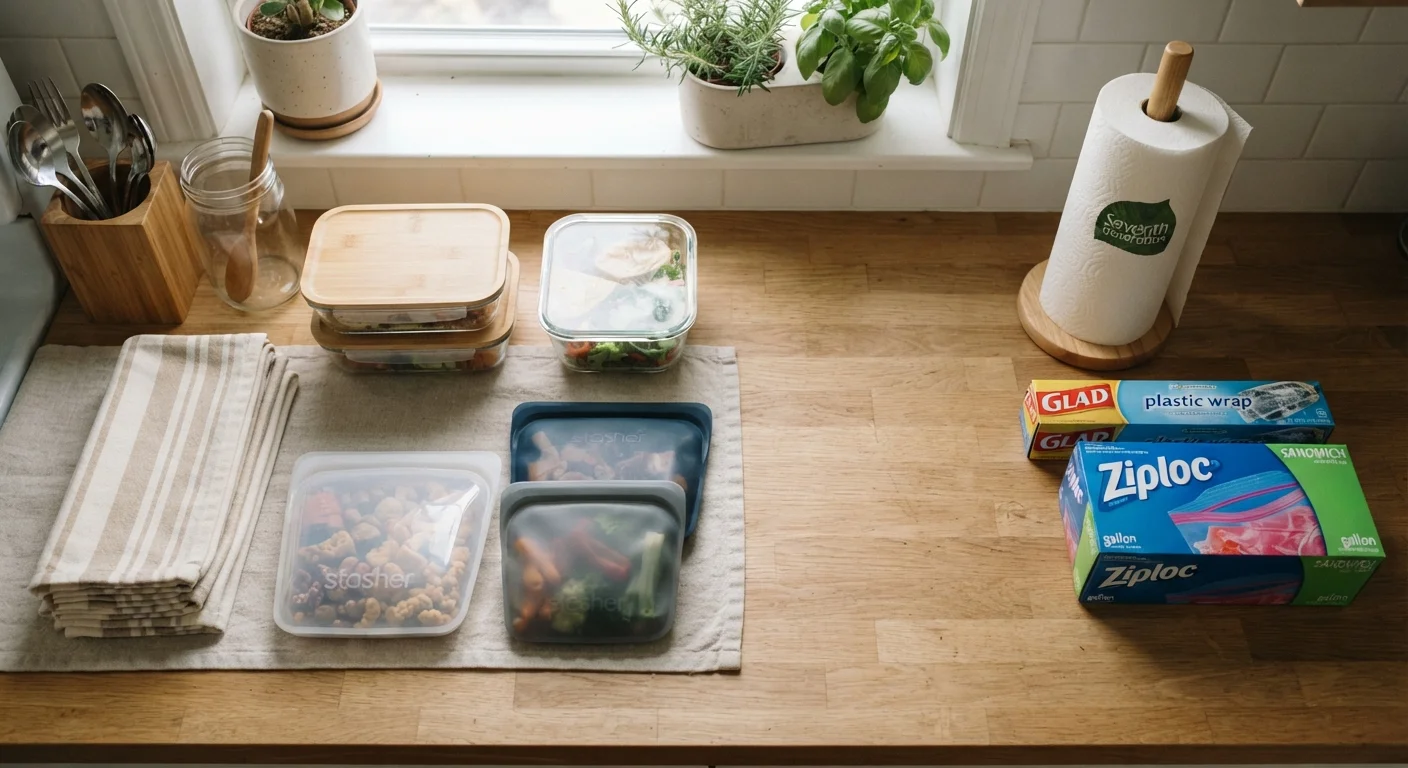
Option A
Reusable household items
The upfront investment that pays back over time.
Best for: Households with consistent routines and space to store, clean, and maintain items long-term.
Option B
Single-use household items
The convenient, low-commitment option for daily tasks.
Best for: Situations where hygiene, time pressure, or storage constraints make reusables impractical.
What the cost comparison actually looks like
The math on reusable versus single-use items is straightforward in principle but easy to misread in practice. A pack of paper towels costs a few dollars and feels cheap. A set of cloth towels costs more upfront. The breakeven point depends entirely on how often a household uses and replaces the disposable version.
For items used daily, such as paper towels, plastic zip bags, or disposable wipes, the cumulative annual spend can reach well into the tens of dollars per category. Reusable alternatives typically pay for themselves within a few months under the same conditions. For items used rarely, the calculus flips: a reusable version may sit unused long enough that the disposable option would have cost less overall.
Household spending categories most families overlook points out that small recurring purchases often go untracked. Paper goods and disposable kitchen supplies fall into exactly this pattern, making them one of the more realistic areas to reclaim budget over a full year.
| Criterion | Reusable items | Single-use items |
|---|---|---|
| Upfront cost | Higher | Lower |
| Long-term cost | Lower with regular use | Accumulates over time |
| Maintenance required | Washing, drying, storage | None |
| Hygiene control | Requires proper cleaning | Consistent, no cross-use |
| Storage space | Dedicated space needed | Compact until used |
| Best use frequency | Daily or near-daily tasks | Occasional or hygiene-critical tasks |
| Environmental load | Lower over full lifespan | Higher due to volume of waste |
Convenience is a real cost, not an excuse
Reusable items require washing, drying, and storage. That is not a flaw to dismiss; it is a genuine demand on time and space. For a household with a working parent and young children, the extra steps of laundering cloth towels or hand-washing silicone bags may not be worth the savings. For a household with reliable routines and a dishwasher, those same steps add almost nothing to an existing workflow.
Saving money vs. saving time covers a useful framework for exactly this kind of decision. The core question is whether the time cost of maintaining a reusable item exceeds the money saved by not repurchasing the disposable equivalent.
Single-use items also win in situations where hygiene cannot be compromised. Disposable gloves, medical-adjacent wipes, and paper products in a sick household carry a hygiene benefit that reusables cannot match unless the household has both the time and equipment to sanitize items properly between uses.
Where reusables tend to deliver the clearest payoff
Some categories are straightforward. Cloth kitchen towels, reusable water bottles, glass food storage containers, and silicone baking mats all hold up well to repeated use and have a long replacement cycle. Families who cook regularly at home get the most from these because the items are in use often enough to offset the purchase price quickly.
Reusable grocery bags are another low-effort swap. They cost very little, require minimal maintenance, and most households already have a place to store them. The savings per bag are modest, but the habit removes a recurring small expense entirely.
Food storage is one area where the quality of the reusable item matters more than people expect. Cheap containers that warp, crack, or stain quickly are not actually reusable in any meaningful sense. Spending a bit more on durable glass or food-grade silicone products tends to produce a longer useful life and a better cost outcome than buying a low-cost option that needs replacement in a year.
For families interested in reducing kitchen waste more broadly, batch cooking pairs naturally with reusable storage, since cooking in volume requires reliable, repeated-use containers rather than a supply of disposable bags or wrap.
Where single-use items remain practical
Some situations genuinely favor disposables. Parchment paper and disposable gloves are difficult to replace without meaningfully changing the task. Disposable plates and cutlery make sense at large gatherings where washing up is impractical. Sanitary and medical items, wipes for diapering, disposable masks, bandaging materials, belong in the single-use category on hygiene grounds alone.
Travel is another case. Reusable containers are useful at home, but carrying them through a long day away from home introduces inconvenience that may not be worth the trade. A small number of disposable bags on a travel day is a reasonable exception to an otherwise reusable routine.
The goal is not to eliminate disposables entirely but to be deliberate about which ones earn their place in the household. A habit of reaching for a paper towel to blot something greasy is different from using a roll a week on tasks a cloth could handle just as well.
This article is for general informational purposes only and does not constitute financial, medical, or professional advice. Consult a qualified professional for decisions specific to your circumstances.
The content provided on our blog site traverses numerous categories, offering readers valuable and practical information. Readers can use the editorial team’s research and data to gain more insights into their topics of interest. However, they are requested not to treat the articles as conclusive. The website team cannot be held responsible for differences in data or inaccuracies found across other platforms. Please also note that the site might also miss out on various schemes and offers available that the readers may find more beneficial than the ones we cover.