

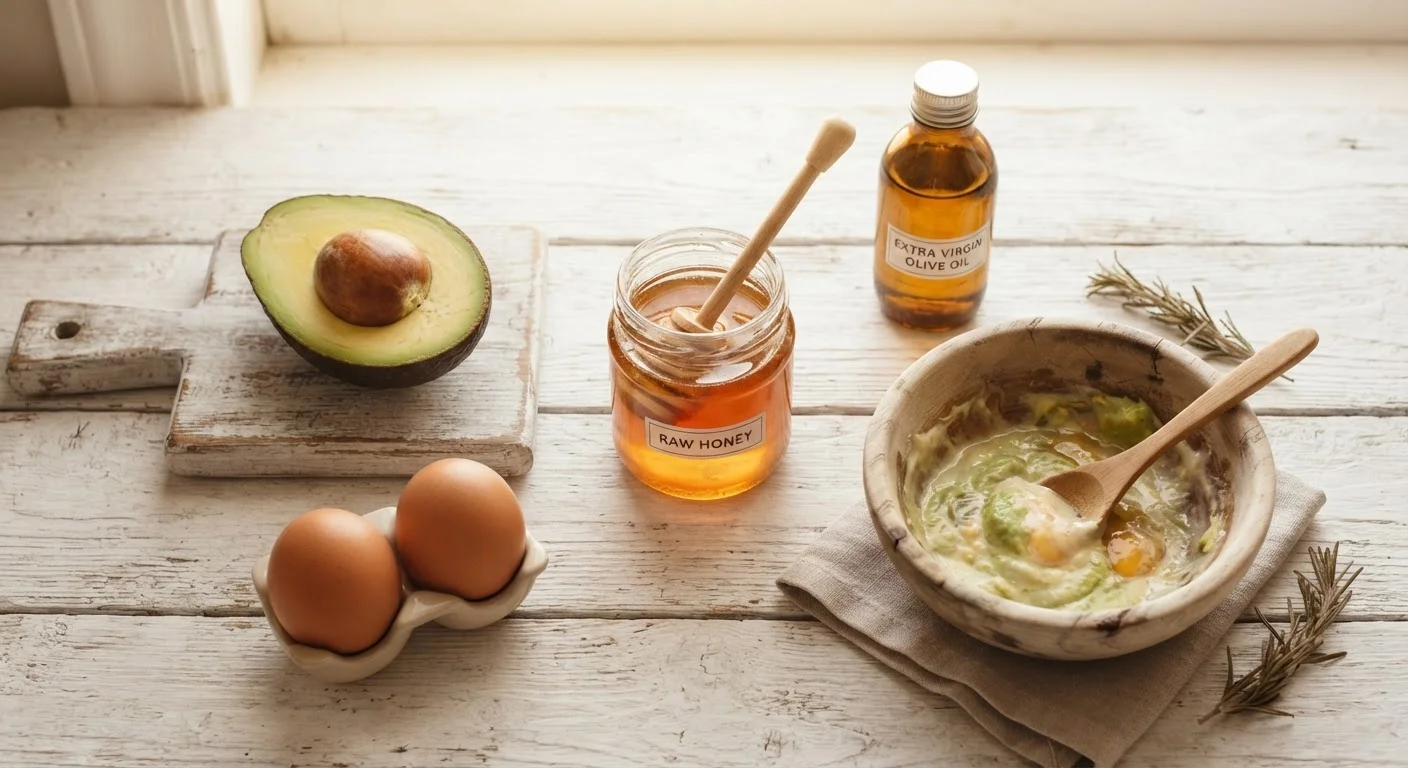
What kitchen ingredients can actually do for hair
Hair is composed primarily of keratin, a fibrous protein. The shaft itself has no living cells, so topical treatments cannot "repair" it in the way that skin heals. What they can do is temporarily smooth the cuticle (the outer scale-like layer), add surface lubrication, or reduce friction, each of which produces visible improvements in texture and manageability.
That is a worthwhile outcome, and it explains why some DIY masks have real, measurable effects. The limitation is that those effects wash out over time, which means consistency matters more than any single application. It also means that expensive salon masks and a well-formulated kitchen blend can sometimes produce similar short-term results on the same hair type.
If you want to get more out of a lean beauty routine overall, see how building a complete beauty kit on a tight monthly budget shapes what you actually need on your shelf.
DIY masks are not a substitute for treatment
If you are experiencing significant hair loss, scalp inflammation, or persistent breakage, a DIY mask will not address the underlying cause. These conditions may have medical origins. A dermatologist or trichologist can give you accurate guidance tailored to your situation.
Ingredients that work and how to use them
A handful of common pantry items have solid evidence or well-understood chemistry behind them. The practices below focus on those, with specific application notes so the benefit is not lost in execution.
Use whole eggs or egg yolks on dry, porous, or chemically treated hair.
Eggs contain proteins and fatty acids that temporarily bind to the hair shaft, which can reduce breakage and improve smoothness after rinsing. The benefit is modest and short-term, but consistent use gives cumulative results on damaged hair.
Apply honey as a humectant, not as a standalone treatment.
Honey draws moisture from the air into the hair shaft, which helps with softness and manageability. Its effect is real but mild, and it works better as an ingredient in a carrier oil blend than when applied on its own, where it can become sticky and difficult to remove.
Choose oils based on molecule size, not just popularity.
Coconut oil has a small enough molecular structure to penetrate the hair cortex and reduce protein loss during washing. Larger oils like argan or castor sit on the surface instead, which can add shine but does not change hair structure from within.
Dilute acidic ingredients before any scalp contact.
Apple cider vinegar at full strength has a pH low enough to cause irritation or chemical burns on a sensitive scalp. Diluted to a ratio of roughly one part vinegar to four parts water, it can help smooth the hair cuticle and remove product buildup without significant risk.
Always do a patch test 24 hours before applying a new ingredient to your full head.
Contact dermatitis from common food allergens, such as eggs or tree-nut oils, can cause scalp redness, itching, or swelling. A patch test on the inner arm or behind the ear catches reactions before they become widespread.
What to skip or treat with caution
Some widely shared DIY hair tips circulate because they sound plausible, not because the chemistry supports them.
- Mayonnaise: Contains oil and egg, both of which have real conditioning properties. However, the full formulation also includes vinegar and stabilizers in unpredictable ratios, so applying the component ingredients separately gives you more control over what you are putting on your hair.
- Baking soda: Has a high pH (around 9) and will strip the natural oil layer from both scalp and hair shaft. Repeated use causes dryness and breakage, particularly on color-treated or fine hair. This one should be avoided as a hair treatment.
- Lemon juice neat: Highly acidic when undiluted, it can irritate the scalp and weaken the cuticle with repeated use. Sun exposure after application can also cause uneven lightening. Always dilute and rinse thoroughly.
- Cinnamon and other spice pastes: Frequently shared as scalp stimulants, but cinnamon can cause chemical burns on the scalp even at low concentrations. There is no reliable evidence it produces meaningful hair growth, and the risk is real.
The pattern across the items to skip is roughly the same: they are too alkaline, too acidic, or too irritating for regular scalp contact. A sharper grasp of what ingredients actually cost versus what they do connects naturally to affordable self-care habits that support skin and scalp health.
Getting consistent results at low cost
The gap between a DIY mask that works and one that does nothing usually comes down to application technique and realistic expectations, not ingredient cost.
Frequency matters more than intensity. A simple egg-and-oil mask once every two weeks on dry or color-treated hair will generally do more over a month than a complex ingredient mix applied once. Hair that is oily at the roots needs conditioning only at the ends to avoid buildup that weighs strands down.
Storage is also worth thinking about. Any mask with egg, yogurt, or fresh fruit should be mixed fresh and used immediately. Oil-only blends can be kept in a sealed jar for several weeks if stored away from heat and light.
The content provided on our blog site traverses numerous categories, offering readers valuable and practical information. Readers can use the editorial team’s research and data to gain more insights into their topics of interest. However, they are requested not to treat the articles as conclusive. The website team cannot be held responsible for differences in data or inaccuracies found across other platforms. Please also note that the site might also miss out on various schemes and offers available that the readers may find more beneficial than the ones we cover.