

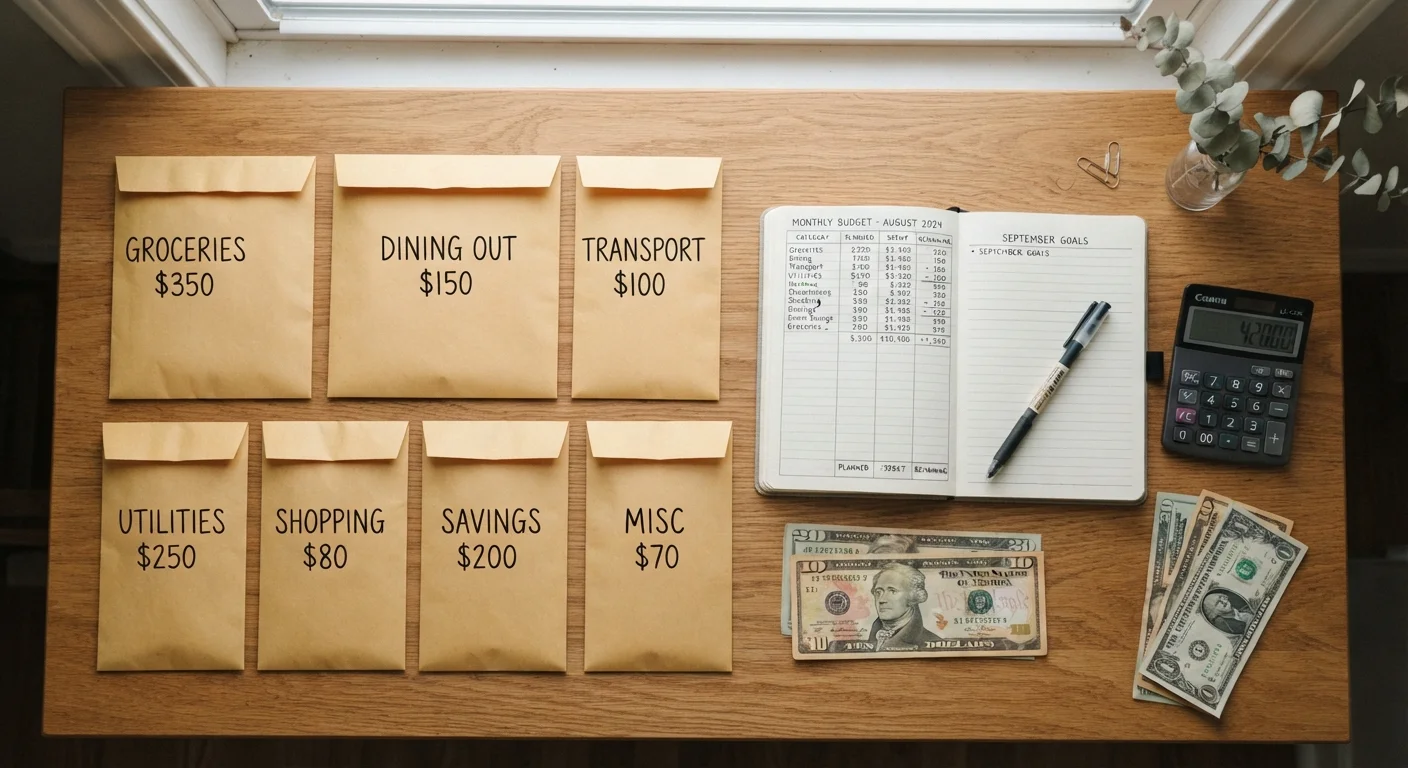
Option A
Envelope budgeting
The tactile, cash-first approach to spending limits.
Best for: Families who overspend with cards and want a physical, category-by-category spending boundary.
Option B
Zero-based budgeting
The deliberate, assign-every-dollar method.
Best for: Households that want a complete picture of where every dollar goes each month, using any payment method.
What each method actually does
Envelope budgeting divides take-home pay into categories, and a set amount of cash goes into a labeled envelope for each one: groceries, gas, entertainment, and so on. When the envelope is empty, spending in that category stops until the next funding date. Some households use physical cash; others use a digital equivalent where virtual envelopes hold earmarked balances.
Zero-based budgeting starts with total monthly income and subtracts every planned expense, savings contribution, and debt payment until the remaining balance is zero. Every dollar has an assigned job. The goal is not to spend everything but to make a deliberate decision about every dollar, including moving money into savings or an emergency fund. See a plain-language introduction to household budgeting for a broader look at building these habits from scratch.
How they compare side by side
Both methods share the same core idea: spending should follow a plan, not a feeling. The differences show up in how each method enforces that plan and who it suits most.
| Criterion | Envelope budgeting | Zero-based budgeting |
|---|---|---|
| Core mechanism | Cash divided into category envelopes | Every dollar assigned a purpose on paper |
| Payment method | Cash preferred; digital versions exist | Works with cash, card, or digital payments |
| Setup time | Low: label envelopes, divide cash | Moderate: build a full monthly plan |
| Spending enforcement | Physical limit when envelope empties | Requires self-monitoring against the plan |
| Handles irregular income | Harder; fixed amounts per envelope | Easier; rebuild plan each month |
| Covers savings goals | Only if a specific envelope is created | Built into the dollar-assignment process |
| Learning curve | Minimal | Low to moderate |
Envelope budgeting is concrete. You either have cash in the envelope or you do not. Zero-based budgeting is comprehensive. It accounts for every dollar, including irregular expenses and savings goals, which envelopes can miss if you do not create one for every category. For a fuller picture of how income, spending, and saving fit together, see how a household budget works in practice.
Common friction points and how to handle them
Envelope budgeting runs into trouble when most spending happens online or through a card. Carrying cash to every transaction takes discipline, and some categories, like utilities and subscriptions, do not translate easily to physical envelopes. Digital envelope apps can bridge the gap, but they add a layer of tracking that removes some of the simplicity.
Zero-based budgeting takes more time upfront each month. Households with irregular income, such as those with gig work or seasonal jobs, need to build the plan around a conservative estimate of income rather than a fixed paycheck, which requires some comfort with monthly recalculation. It also demands honest accounting for categories that are easy to underestimate, like car maintenance or kids' school expenses.
Both systems benefit from a monthly review. A practical walkthrough for building a budget that holds covers how to set categories and adjust when spending goes off plan.
When your income arrives mid-month
Both methods assume you can fund categories at the start of a cycle. If your pay arrives on different dates, consider budgeting from each paycheck rather than monthly. Assign categories to the paycheck that most closely matches when those bills are due. This reduces the gap between planning and actual cash availability.
Choosing the approach that fits your household
The right method is the one your household will actually use for more than two months. If tracking a spreadsheet every night sounds like homework you will skip, physical envelopes remove that barrier. If carrying cash feels impractical, zero-based budgeting with a simple app or notebook works with any payment method.
Some families combine elements of both: they use zero-based planning to assign every dollar at the start of the month, then move cash into envelopes only for the categories where overspending is a recurring problem. There is nothing wrong with that hybrid. The method is a tool, not a rule.
Whichever system you use, it pairs well with a clear-eyed look at whether to build an emergency fund or pay down debt first, since both budgeting methods work better when you have a plan for unexpected expenses too. For households still setting up the basics, managing home expenses strategically offers a useful starting framework.
This article is for general informational purposes only and is not personalized financial advice. Consider speaking with a qualified financial professional about decisions specific to your household's situation.
The content provided on our blog site traverses numerous categories, offering readers valuable and practical information. Readers can use the editorial team’s research and data to gain more insights into their topics of interest. However, they are requested not to treat the articles as conclusive. The website team cannot be held responsible for differences in data or inaccuracies found across other platforms. Please also note that the site might also miss out on various schemes and offers available that the readers may find more beneficial than the ones we cover.