

Start here
What time blocking actually is
Understand the problem
Why families struggle with standard schedules
Get started
How to build your first family time block
Build the habit
Making it stick over the long term
What time blocking actually is
Time blocking is a scheduling method where you divide the day into named segments and assign a category of activity to each one. Instead of a list of tasks you hope to complete, you have a map of when each type of task will happen.
The core idea is simple: when a slot on your calendar reads 'school pickups and snack' from 3:00 to 4:00 p.m., that window is already spoken for. You do not have to decide in the moment whether to stop working, run an errand, or start dinner prep. The decision was made in advance.
Time block
A named segment of the day reserved for a specific category of activity, such as 'morning routine' or 'homework time.' It has a start and end point and a single purpose.
Fixed commitment
An activity with a set time that cannot move, such as a school bell, a work shift, or a recurring appointment. These form the anchors around which other blocks are arranged.
Buffer block
A short block of unscheduled time built into the day on purpose to absorb overruns, transitions, or unexpected tasks. Without buffers, one delay can push the entire schedule back.
Weekly template
A reusable draft of your most typical week, used as a starting point each Sunday. You modify only what has changed rather than rebuilding the schedule from scratch each time.
This differs from a basic to-do list because time blocking forces a reality check. If you try to fit eight hours of tasks into a five-hour window, the conflict is visible before the day begins. That visibility is the main reason the method helps families more than a running list of intentions.
Why families struggle with standard schedules
Most households run on a mix of fixed commitments (school start times, work shifts, recurring appointments) and a loose assumption that everything else will get done somehow. That gap between fixed and flexible is where family stress accumulates.
When afternoon time is unstructured, the default tends to be whatever feels most urgent or most entertaining at the moment. Homework gets pushed, dinner happens late, and the evening becomes rushed. None of this is a failure of effort; it is what happens when time has no assigned purpose.
Standard schedules also tend to ignore transition time. Getting four people out the door in the morning takes longer than any individual task on the list, but most schedules treat it as zero-cost. Time blocking makes you assign realistic windows to transitions, which reduces the friction that makes mornings feel chaotic. If you want more on morning structure specifically, see low-effort morning routines that reduce household chaos.
How to build your first family time block
Start with one weekday, not the whole week. List every activity that has to happen that day: school drop-off, work hours, pickups, meals, homework, any appointments. Note roughly how long each takes, including the transitions between them.
Group related activities into blocks. 'After-school block' can cover pickup, snack, and homework together. 'Evening block' can hold dinner, cleanup, and wind-down. Broad blocks are more durable than narrow ones because a 15-minute overrun in one activity does not destroy the rest of the day.
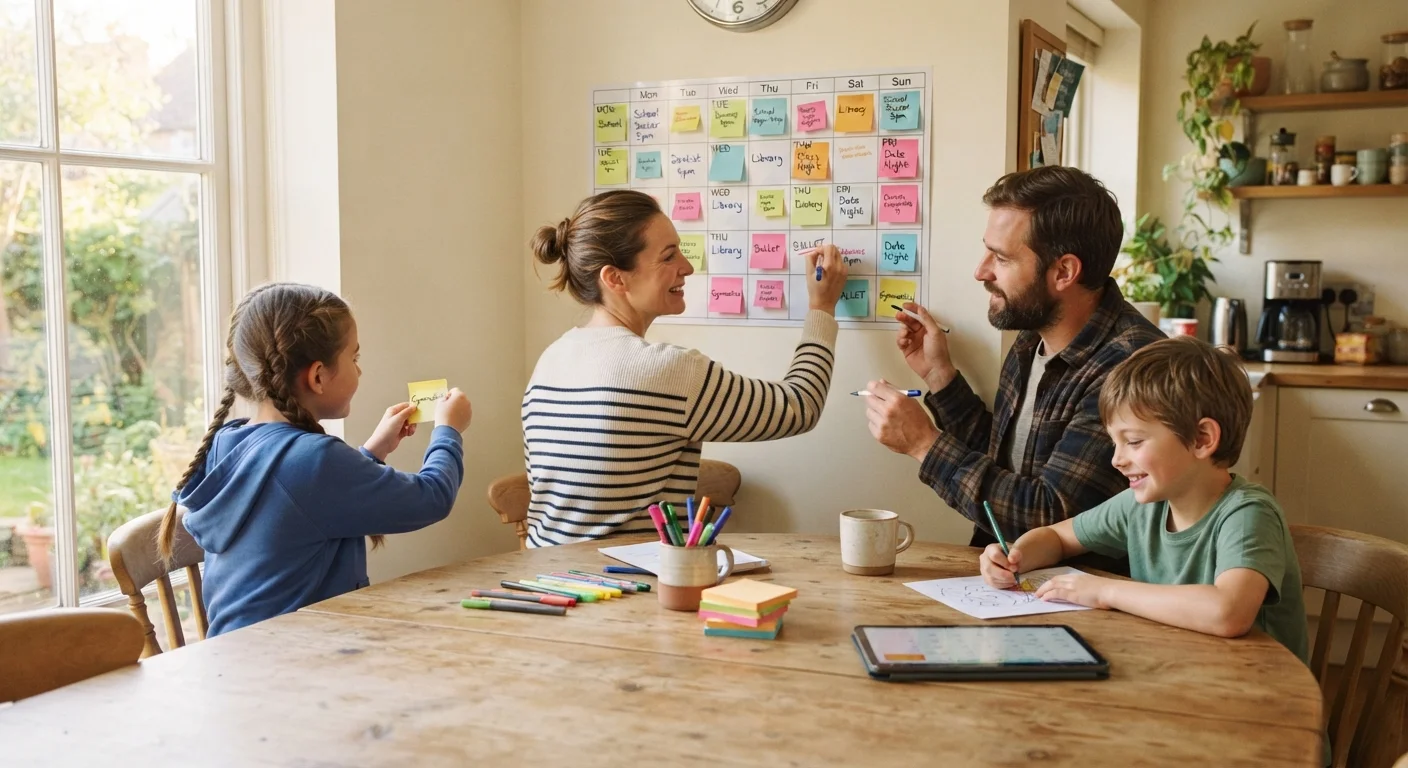
Write it somewhere visible to the whole family. A whiteboard on the fridge costs a few dollars and puts the schedule where everyone can see it. Visibility matters because the schedule only helps if people know it exists.
Start with two or three blocks, not a full day
If a complete daily schedule feels overwhelming, block only the two or three parts of the day that cause the most friction. For many families that is the morning rush and the after-school window. Getting those two segments structured often produces an immediate improvement without requiring a full redesign of the day.
Once one weekday feels manageable, map a second. Build toward a full weekly template gradually rather than redesigning everything at once. The habit stacking approach for busy families pairs well here: attaching the weekly planning session to an existing Sunday routine (coffee, a meal, a regular show) makes it easier to keep.
Making it stick over the long term
The most common reason time blocking stops working is that the initial template goes stale. A schedule built in September does not fit February when extracurricular activities have changed. A brief weekly review, 10 to 15 minutes on Sunday evening, is enough to update blocks before the week starts.
Treat the schedule as a draft, not a contract. When a block consistently fails because it is too narrow or placed at the wrong time of day, change it. The goal is a schedule that reflects real life, not one that makes you feel behind by Tuesday.
Time blocking also connects directly to household financial habits. Planned time for meal prep reduces last-minute spending on takeout. Scheduled grocery planning prevents duplicate purchases. If you are also working on household budgets, the guide to managing home expenses strategically covers how structured planning in one area tends to reinforce it in others.
Children who participate in building their own afternoon blocks tend to follow them more consistently. A simple grid with three or four named slots, drawn together on a Sunday, gives school-age kids enough structure to self-manage homework and screen time without constant reminders.
Frequently Asked Questions
Time blocking means setting aside a named chunk of time for a specific activity instead of working from a general to-do list. For example, Tuesday from 5:00 to 6:00 p.m. becomes 'homework and reading' rather than just 'do homework sometime today.' Assigning time to tasks makes it more likely they actually happen.
No paid tool is required. A printed weekly grid, a whiteboard on the fridge, or a free calendar app on your phone all work equally well. The method depends on the habit of planning, not on any particular product.
Family blocks work better when they are broader rather than narrower. A 90-minute 'evening routine' block handles dinner, cleanup, and bath time more reliably than three separate 30-minute slots that each depend on the previous one ending on time.
A short weekly planning session, typically 10 to 15 minutes, lets you adjust blocks before the week starts rather than improvising daily. Keep a template of your most common week and modify only what has changed.
Yes. School-age children can help decide when homework, screen time, and outdoor play fit into the afternoon. Letting kids have input increases buy-in and teaches them basic self-scheduling, which is a useful skill on its own.
A traditional schedule lists events with fixed start times, like a school timetable. Time blocking goes further by assigning every significant chunk of the day to a purpose, including buffers and rest, so unplanned time does not simply disappear into low-priority activities.
The content provided on our blog site traverses numerous categories, offering readers valuable and practical information. Readers can use the editorial team’s research and data to gain more insights into their topics of interest. However, they are requested not to treat the articles as conclusive. The website team cannot be held responsible for differences in data or inaccuracies found across other platforms. Please also note that the site might also miss out on various schemes and offers available that the readers may find more beneficial than the ones we cover.